


Exploring How Clixie Platform Adds Value to L&D Content in LMS
The purpose of this document is to explain how the current Clixie platform immediately adds value to Learning and Development (“L&D”) content.


Clixie adds value to the LMS by:
The “clixified” content (also known as “stories”) can be delivered to learners in many ways, but the focus will be on learners accessing the content in a Learning Management System (“LMS”) environment. The assumption is that multiple LMS’s may be used in the same environment. This is referred to as a distributed multiple LMS ecosystem but will be referred to as the LMS in this document.
- Acting as a single source of truth for L&D content;
- Improving the learning experience and learner outcomes;
- Providing real-time data on when a learner requires corrective action;
- Greatly improving efficiencies (time, resources and expense) in L&D content creation and delivery;
- Seamlessly integrating into multiple applications (Canvas, Webex, Microsoft Teams and Zoom); and,
- Automating adding interactive elements to video and audio content using OpenAI and other Artificial Intelligence (“AI”) platforms.
Clixie has an easy-to-use app that creates chapters, quizzes and other engaging, interactive elements for recorded video and audio content. As we incorporate more AI functionality into Clixie, the creation of interactive content is becoming easier and faster than ever before. We provide complete, real-time data on learner interaction with customized dashboards. Clixie’s app is a secure, cloud-based authoring platform, but we also offer turnkey content creation services. Clixie is a trusted solutions provider for many organizations such as Google, The University of Michigan, and Claro. Clixie was featured at the xAPI cohort (corporate LMS platforms).
Acting as a single source of truth for L&D content?
Clixie has an easy, no-code application that is cloud-based and can be learned via short training videos and/or one-on-one sessions. Interactive Training content can be shared across multiple LMS platforms with all of the user activity data in one place.
Improving the learning experience and learner outcomes
At the University of Michigan – Ross School of Business, Clixie was used to help the students prepare for classes, study for exams and provide information. Students that use Clixie during class had an average score of 10% higher than students that did not use Clixie. Students that used Clixie to study for exams increased their scores by an average of 12%. Students were an average of fifteen times more likely to watch the videos that had Clixie’s interactivity than if they were offered as individual lecture videos.
Providing real-time data on when a learner requires corrective action
Clixie can alert key stakeholders when learners are falling behind, either through taking too long or having low scores, in plenty of time to take corrective action. This can be achieved through automated notifications or in the Clixie dashboard.

“Our venture capital class uses ‘clixified’ videos to enhance the students’ learning and extend that learning beyond the bounds of a traditional classroom. We are excited to continue working with Clixie in improving the educational experience.”
David Brophy Professor of Finance, Ross School of Business, University of Michigan
Greatly improving efficiencies (time, resources and expense) in L&D content creation and delivery
Clixie acts as an effective, no-code app that can be easily embedded into other platforms or used as a stand-alone platform to quickly create engaging content. No special expertise, hardware or expense required.
Seamlessly integrating into multiple applications (Canvas, Webex, Microsoft Teams and Zoom)
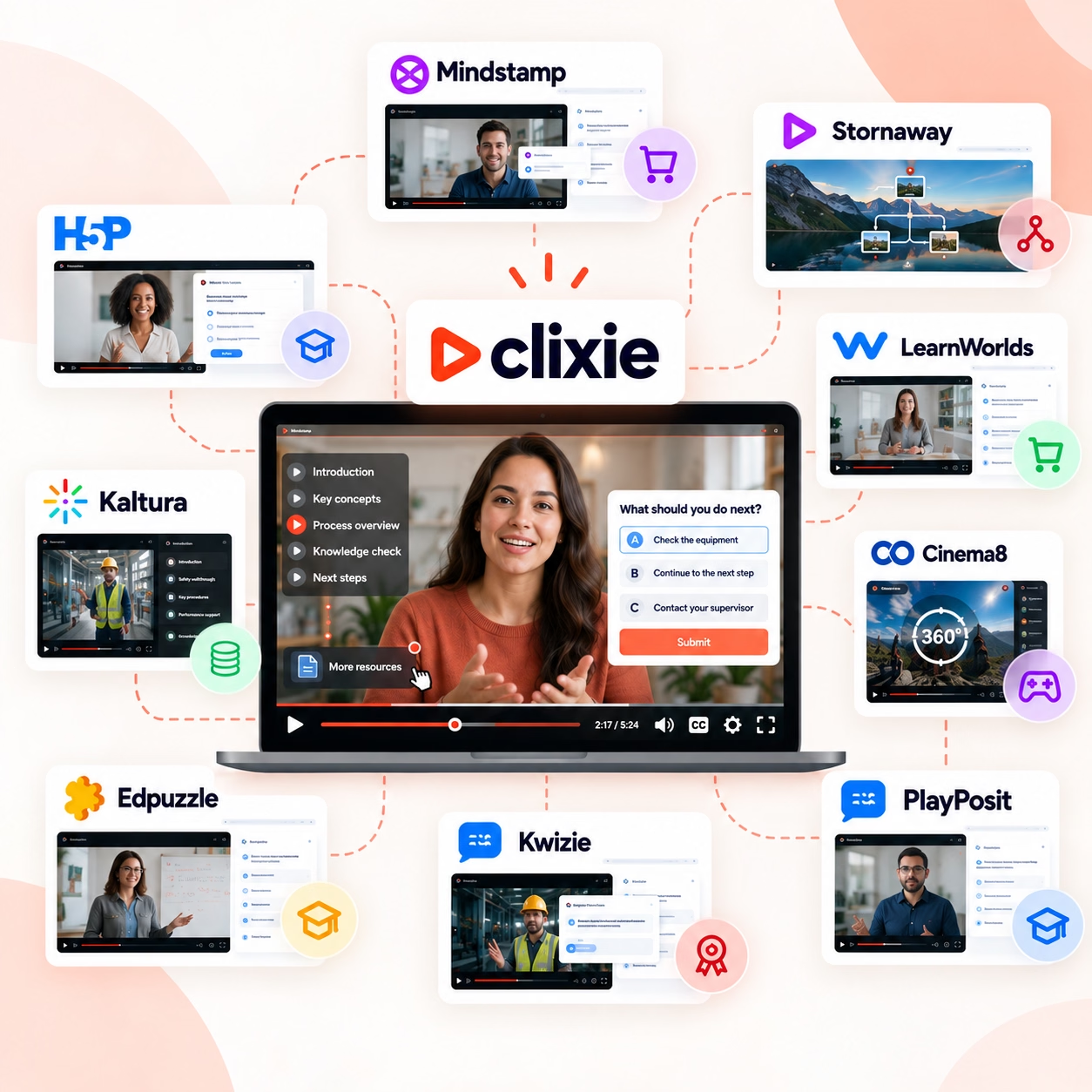
Clixie stories are naturally embedded into LMS pages and content via industry standard protocols (SCORM and xAPI packages) and can be directly inserted anywhere as a URL, embed code or iFrame. Clixie serves as an embedded app in the Canvas LMS, Webex, Teams and Zoom to easily create content from recordings with a simple click.
Automating adding interactive elements to video and audio content using OpenAI and other Artificial Intelligence (“AI”) platforms
Clixie already uses a combination of AI platforms to create website summaries, automated quiz creation, transcription and other features. The goal is to almost entirely automate the process of adding interactivity to learning content.
Summary
Prior to recently, video-based learning was only feasible in the most rigorous, expensive training environments due to expense. Then, when consumer-grade video became widely accessible for a variety of uses, learners grew weary of watching boring, conventional training movies.
However, as a sector, we couldn't stand by and allow that to happen, so we developed interactive video features to raise learner engagement. LMS providers are now taking action to ensure that learning results advance. And I hope you're eager to use these skills whenever they're more generally accessible. The digital learning sector is experiencing fascinating times right now.
If you’ve enrolled in any online courses lately, you’ve probably crossed paths with interactive video content. But just how well are learning platforms supporting this rapidly growing trend? That question has been on my mind while I’ve been evaluating LMS vendors for the 2023 Learning Systems Awards.
Clearly, instructional videos aren’t new. In fact, historians say the first educational films appeared as far back as the early 1900s. Next, fast-forward to the start of this century. That’s when video took a huge step forward with the arrival of high-speed internet connectivity. This made it possible for digital video to play a central role in online and hybrid learning.
.png)
.png)



.avif)
